Short answer: If your sockets are dead but the lights work and nothing in the consumer unit has tripped, the usual cause is a broken connection on the socket circuit. That might be a loose or burnt terminal behind one socket, a failed joint under the floor, or an old fuse that has blown. Stop using that circuit and get it tested.
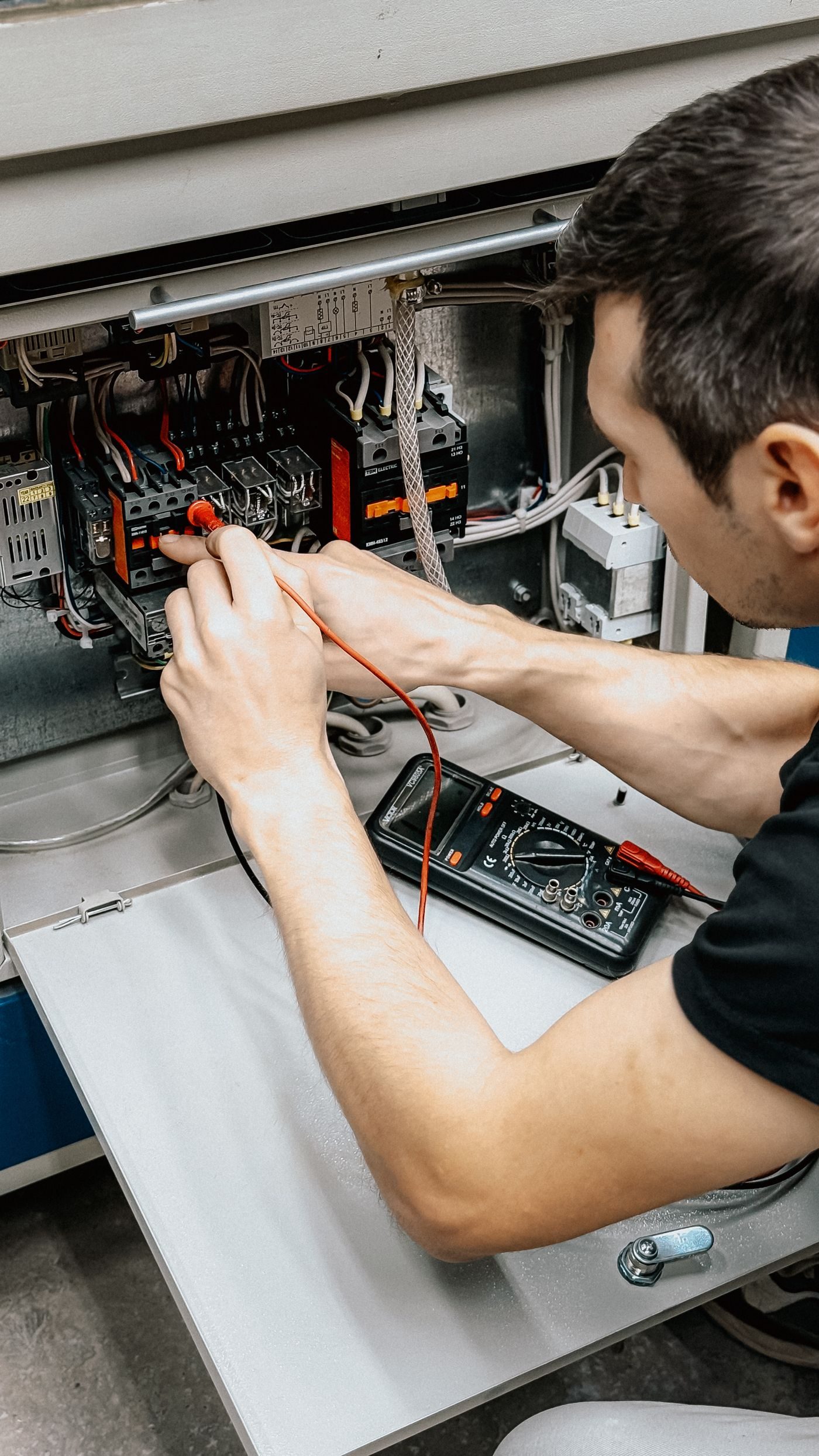
You plug in the kettle and nothing happens. The lights are fine. You check the consumer unit and every switch is up. This is one of the most confusing faults in a home, and one of the most common calls an electrician gets.
Why nothing trips
Circuit breakers and RCDs are designed to trip when something goes wrong in a specific way. An MCB (miniature circuit breaker) trips when too much current flows, such as an overload or a short. An RCD (residual current device) trips when current leaks to earth.
A broken connection does neither. If a wire comes loose, current simply stops flowing past that point. Nothing overloads and nothing leaks, so nothing trips. The circuit just goes dead.
That is why this fault needs fault finding, the process of testing a circuit section by section until the break is found. Our electrical fault finding service is built around exactly this.
How socket circuits are wired
Most UK homes use a ring final circuit for sockets. The cable leaves the consumer unit, runs from socket to socket around the house, and returns to the same breaker. Power can reach each socket from both directions.
Because of that loop, a single break does not always kill every socket. Often:
- some sockets keep working, fed from the other side of the ring
- the sockets beyond a second break go dead
- or the whole ring goes dead if the fault is near the consumer unit
Some homes also have radial circuits, where cable runs out to the sockets and stops. Kitchens, extensions and loft conversions are often wired this way. A break on a radial kills everything past that point.
Common causes in London homes
| Cause | Typical sign | Where we find it |
|---|---|---|
| Loose terminal behind a socket | One socket dead, or a group past it dead | Sockets that have had heavy loads, such as heaters |
| Burnt terminal | Brown marks, burning smell, warm faceplate | Sockets used for tumble dryers, heaters, kettles |
| Failed joint under the floor | Whole run dead, no visible sign | Older rewires and extensions in Victorian terraces |
| Old rewireable fuse blown | Fuse wire broken in a pull out carrier | Fuse boxes still in use |
| Damaged cable | Dead after a nail, screw or drill went into a wall | After shelves, kitchen fitting or flooring work |
| Faulty fused spur | Only appliances on that spur dead | Fridges, boilers and extractor fans |
A fused spur is a switch plate with its own small fuse, often used for fixed appliances like a boiler or kitchen appliances. If the fuse inside has blown, the appliance stops while everything else works. This is worth checking first, because it is easy to see.
What you can check safely
- Check the consumer unit. Make sure nothing has tripped. Look at both RCDs and every MCB. If you have an old fuse box, do not take fuses out with the main switch on.
- Try another appliance. A faulty plug or appliance can look like a dead socket.
- Look at the sockets. Check each socket face on the dead circuit for scorch marks, melted plastic or cracks. Do not take any off the wall.
- Feel for warmth. Put the back of your hand near the faceplate. A socket that is warm with nothing plugged in is a warning sign.
- Think about recent work. New shelves, a new kitchen or flooring work often explains a damaged cable.
If you find burning or scorching, switch off at the main switch if you can do so safely, and do not use that circuit again until it has been checked. Our guide to a burning smell from a plug socket explains what to do in that case.
How an electrician finds the fault
An electrician will:
- Isolate the circuit, which means switching it off and proving it is dead.
- Test the ring end to end at the consumer unit to see whether the loop is broken.
- Open sockets one by one, starting where the fault is most likely, looking for loose or burnt connections.
- Test the cable between sockets to narrow the break down to one section.
- Repair the joint or replace damaged cable and sockets.
- Test the circuit again before switching it back on.
In older London houses, the hardest part is often access. Cables in Victorian terraces may run under floorboards, behind lath and plaster, or through loft spaces added later. A fault in a run under a fitted carpet can take longer to reach.
Why this matters in older housing
According to the VOA council tax stock of properties, 29.1% of London homes were built before 1919. In Enfield, 37.3% of homes are terraced houses, the highest share of any of the boroughs we cover. Many of these homes have been rewired once, often decades ago, and had extra sockets added since. Each extra connection is another place a terminal can work loose.
Electrical Safety First recommends an inspection at least every 10 years in an owner occupied home and every 5 years in a rented one. An inspection like this measures each circuit and often finds loose connections before they fail.
Don’t confuse it with half the house off
If a whole set of circuits is off, including some lights, the more likely cause is a tripped RCD. Read half my house has no power for that case.
If you are in a terrace in Enfield, or anywhere in London, and your sockets have gone dead with nothing tripped, stop using the circuit and get it tested. A loose connection that has stopped carrying power has often been getting hot first.
Quick questions
Is it dangerous if sockets stop working without tripping?
It can be. A connection that has come loose can overheat before it fails. If you smell burning or see browning on any socket, switch off at the main switch if safe and get it checked.
Can I find the faulty socket myself?
You can look at the faces of sockets for scorching and feel for warmth without removing anything. Do not take sockets off the wall. Finding the exact fault needs test equipment.
Why do some sockets on the same wall work and others not?
Sockets are often wired in a loop called a ring. A break can leave some sockets on the ring working from one side and others dead, depending on where the break is.
Last updated 23 October 2026. Written for homes in London. Rules can change, so check the linked sources for the latest position.